Dr. Petia Yanchulova Merica-Jones

I work at the Institute of Astronomy at the Bulgarian Academy of Sciences. where I study the interstellar medium, and more specifically the properties of interstellar dust using photometric and spectroscopic observations. I am interested in how dust and the 3D galactic structure together give us a unique perspective on the processes in the nearby universe. My interests are in measuring the dust extinction curves in Local Group galaxies (M31, M33, LMC and SMC), to understand how dust grain properties relate to the surrounding interstellar medium.
Earlier in 2025, I was a Fulbright U.S. Scholar and a postdoctoral researcher at the Department of Astronomy at Sofia University in Bulgaria, where I taught a course on astronomical data analysis and gave talks to students throughout Bulgaria about the newest discoveries of the James Webb and the Hubble Space Telescopes.
Previously, I was a postdoctoral researcher in the ISM*@ST group at the Space Telescope Science Institute, where I worked with Dr. Karl Gordon on measuring interstellar dust extinction in M31, M33 and the SMC, and with Dr. Claire Murray on the Scylla project and other surveys using the BEAST tool to study dust and interstellar medium properties in nearby galaxies.
I received my PhD in Physics with Astrophysics from the University of California, San Diego in 2020 where Karin Sandstrom was my academic advisor.

Research

I am interested in understanding the properties of the interstellar medium (ISM) in nearby galaxies. The ISM, comprised of interstellar dust and gas, and its properties on small and large scales govern galaxy formation and evolution. The Small and Large Magellanic Clouds (SMC & LMC), as well as M31 and M33, are excellent laboratories for observing spatially resolved stellar populations and individual gas/dust clouds enabling a detailed analysis of the ISM and stellar properties. I study the ISM via dust extinction and dust emission, by measuring the dust extinction curve, making dust maps, and comparing dust properties with properties of other components of the ISM. I also study how stellar populations behave as an ensemble and how they interact with the nearby dust and gas.
The Mysterious 2175Å Bump

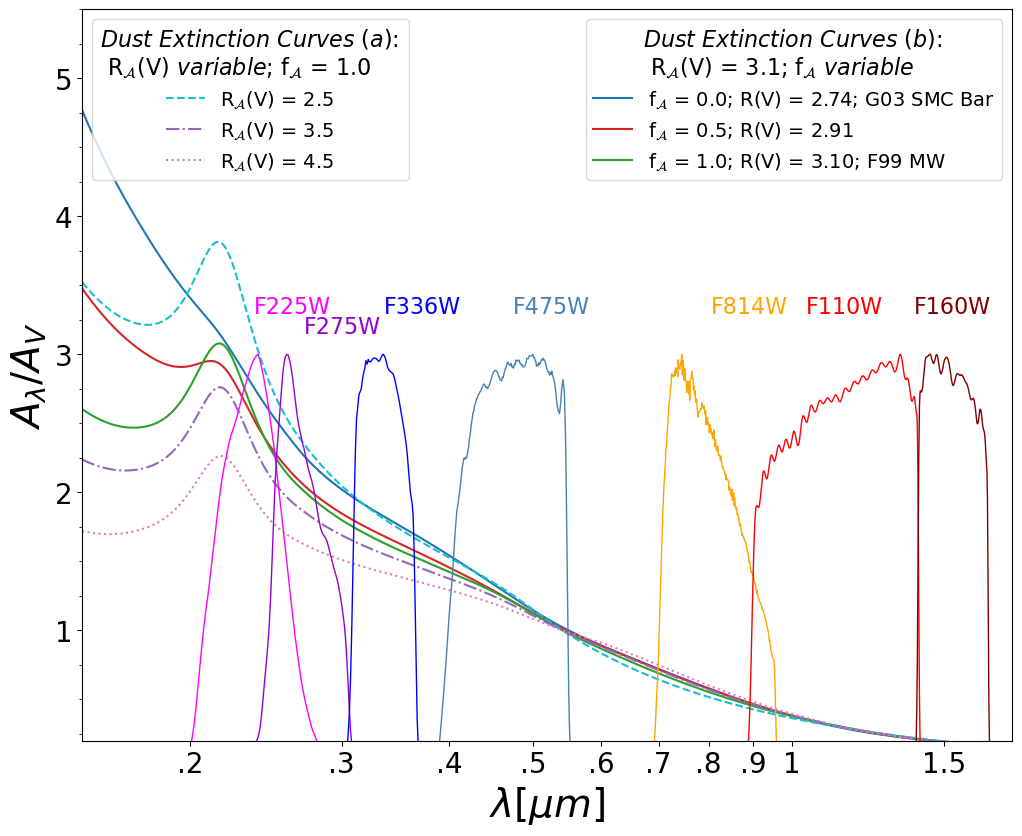
With recent HST/STIS spectroscopic observations (PI P. Yanchulova MJ), we try to understand why most extinction curves in the SMC lack the ubiquitos 2175Å UV absorption feature seen in the Milky Way and in Local Group galaxies. What physical conditions affect this and other extinction curve features, such as the far-UV rise? The SMC is key to studying such variations due to its proximity and unusual ISM environemnt. We observe the spectra of sightlines with a high probability of a 2175Å bump, and correlate dust extinction properties with the ISM environment.
Yanchulova M-J et al. in prep (2025), ApJ

Dust + Stellar Properties

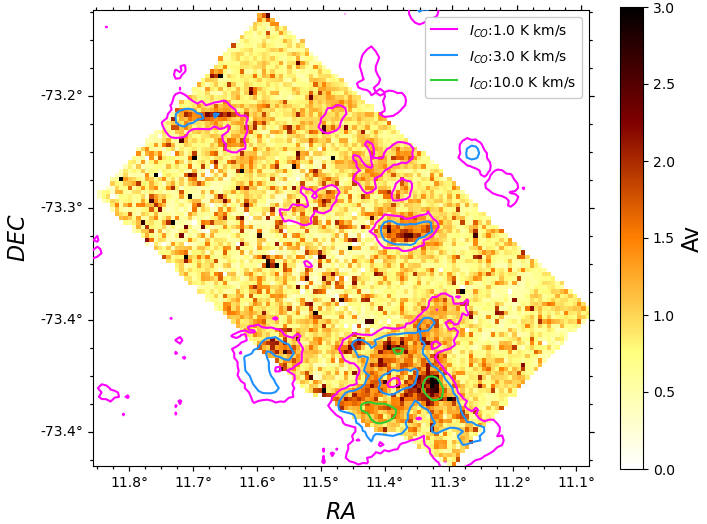
The wealth of information contained in photometric surveys of resolved stars in nearby galaxies - such as Scylla (PI C. Murray ) and SMIDGE (PI K. Sandstrom) - makes it possible to model the stellar and dust properties together. The BEAST tool enables high resolution mapping of stellar and dust properties by fitting the individual stellar photometry to a stellar physics model and models for the dust extinction and observational uncertainties. Additionally, the chemical enrichment and star formation histories can be studied in great detail.
Yanchulova M-J et al. 2025, ApJ

Galactic Geometry

Observations of spatially-resolved stellar populations make it possible to analyze the 3-D structure of the stars, dust, and gas. My thesis focused on modeling the effects of dust extinction and galactic geometry (stellar and dust layer positions and relative offsets) on the CMD of stars in the SW Bar of the SMC. We found that when CMDs are used to study dust extinction in nearby galaxies, the stellar and dust geometry must be modeled as well to properly infer the dust properties.
Yanchulova M-J et al. 2021, ApJ

Dust Extinction

Color-magnitude diagrams (CMDs) of reddened stars can provide rich information about dust extinction properties of nearby galaxies. I use CMDs to study dust extinction as a way to constrain dust grain properties. My research has made use of Hubble Space Telescope observations of resolved stars in the SMC to understand how the dust extinction curve at low-metallicity may be different from that in evolved galaxies. [SMIDGE, PI K. Sandstrom]
Yanchulova M-J et al. 2017, ApJ

Publications

Astronomy Data Service (ADS) Publications Search

  • Large Variations Seen in First Ultraviolet Spectroscopic M33 Dust Extinction Curves, ApJ submitted Aug 2025, K. D. Gordon, P. Yanchulova Merica-Jones, + M33 Extinction Team.
  • Scylla V: Constraints on the spatial and temporal distribution of bursts and the interaction history of the Magellanic Clouds from their resolved stellar populations, The Astrophysical Journal, C. Burhenne and the Scylla Team, Accepted Oct. 2025.
  • Nature or Nurture: LMC-like Dust in the Solar Metallicity Galaxy M31, The Astrophysical Journal, 989 61. G. Clayton, P. Yanchulova Merica-Jones + M31 Extinction Team, Sep 2025.
  • Scylla. IV. Intrinsic Stellar Properties and Line-of-sight Dust Extinction Measurements toward 1.5 Million Stars in the SMC and LMC, Mar 2025, The Astrophysical Journal, 982 33. Lindberg, C. W., Murray, C. E., P. Yanchulova Merica-Jones + Scylla Team, Mar 2025.
  • A Catalog of Stellar and Dust Properties for 500,000 stars in the Southwest Bar of the Small Magellanic Cloud, The Astrophysical Journal, 978 144. P. Yanchulova Merica-Jones et al., 2025.
  • Three-Dimensional Structure and Dust Extinction in the Small Magellanic Cloud, The Astrophysical Journal, 907 50. P. Yanchulova Merica-Jones et al., 2021.
  • The Small Magellanic Cloud Investigation of Dust and Gas Evolution (SMIDGE): The Dust Extinction Curve from Red Clump Stars. The Astrophysical Journal, 847 102. P. Yanchulova Merica-Jones et al., 2017.
  • Teaching

    Sofia University: Python for Astronomy

    "Python for Astronomy" introduced students to using Python for the processing, analysis, and visualization of data from modern astronomical instruments. The training included working with scientific libraries, databases, astrostatistics, Jupyter notebooks (for HST+JWST observations), and automating analyses. The goal was for students to реproduce published scientific results and generate new ones suitable for publication or for planning astronomical observations.
    Course website.

    San Diego Mesa College: Astronomy 101

    "Descriptive Astronomy" was an introductory survey of contemporary astronomy. Topics included the solar system, planetary science, optics basics, stars and stellar evolution, exoplanets, interstellar medium, the Milky Way galaxy and cosmology. The course was designed for students planning to take advanced courses in the physical and earth sciences and for transfer students planning to major in astronomy. Students completed a citizen science project.
    Course website.

    UC San Diego Physics/Astrophysics Dept.

    I was a teaching assistant at the Physics Dept. of the University of California, San Diego. There, I taught these course:
    Phys 7: Galaxies & Cosmology
    Phys 105: Mathematical & Computational Physics
    Phys 120: Circuits and Electronics
    Phys 124: Laboratory Physics/Electronics Projects
    Phys 160: Stellar Astrophysics

    Data

  • SMIDGE SMC Observations Catalog (source for 2017, 2021, and 2025 publications) [SMIDGE, PI K. Sandstrom]
  • Nancy Grace Roman Space Telescope

  • Anyone interested in doing science with Roman can join the Roman Science Collaboration.